


You know the feeling of pulling onto the Boulevard for the first weekend of the season — windows down, that first hit of salt and marsh in the air, the whole island exhaling around you. Here’s something worth carrying on that drive: you are not the only one coming home to the bay right now.
Every June, while the rest of us are dragging beach chairs out of the garage, the northern diamondback terrapin is making its own version of the summer migration. The females climb up out of the Barnegat Bay marshes, hauling themselves across dunes and bulkheads and — yes — roads, looking for a patch of warm, sandy soil to dig a nest. Once you know to look, you’ll see this island a little differently.
A Local You’ve Probably Never Met
The diamondback terrapin is the only turtle in North America that spends its whole life in brackish water — that in-between world of the back bay, where the salt of the ocean meets the fresh of the mainland creeks. Most turtles can’t survive there at all. The terrapin can, because it’s quietly built for it.
Behind each eye sits a salt gland — the same equipment a sea turtle has, and the only turtle in the terrapin’s family tree that carries one. It wrings the excess salt out of the bloodstream and weeps it back out, which is what makes feeding and drinking possible in water that would kill an ordinary pond turtle. Fresh water is a different problem, and the solution is stranger still: terrapins wait for rain. After a storm, a thin skin of fresh water floats on top of the salt, and they surface to drink it right off the top — or tip their heads back and take the drops straight from the sky. Researchers have found they can feel the vibration of oncoming rain even while submerged, and rise to meet it.
This is bay-side water, through and through. Not the surf side — the quiet side, where the sunsets happen and the kids catch crabs off the dock. The terrapin earns its keep there, too: it’s one of the main things holding the marsh periwinkle snail in check, and left unchecked, those snails can chew a healthy salt marsh down to mud.
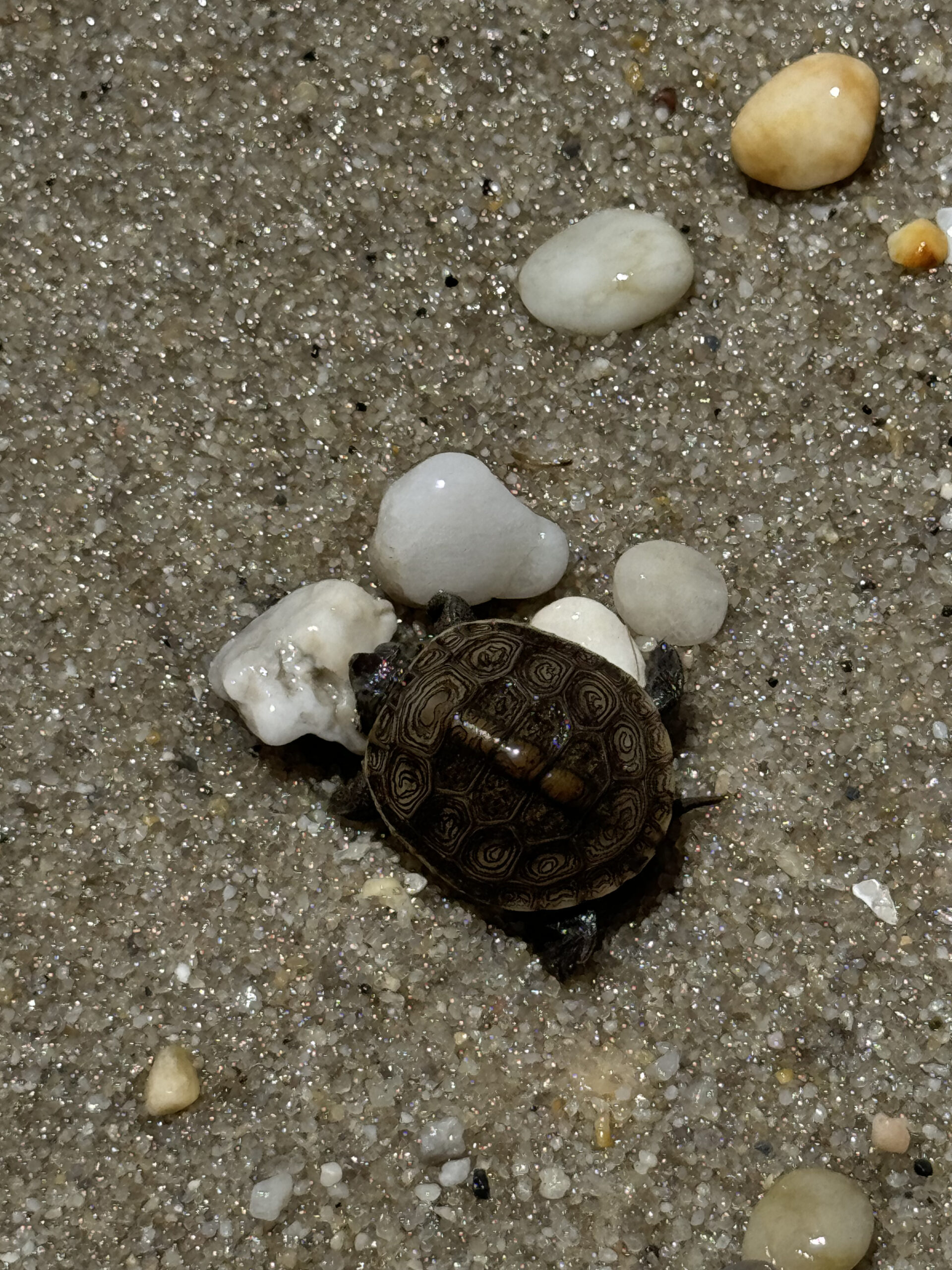
The name comes from the diamond-shaped rings stamped into the plates of the gray-green shell. Those plates are called scutes, and they’re made of keratin — the same material as your fingernails. The pattern is unique to each animal; the shell, and the scatter of black flecks across the pale gray skin, are as singular as a fingerprint. No two terrapins on this island look exactly alike.
You’ll read in a lot of places that you can count those rings like the rings of a tree to read the animal’s age. It’s a tidy idea, and people have tried — but here’s what rarely gets mentioned: scientists have never been able to confirm the math holds up. The rings crowd together and go quiet with age, and growth slows to a creep. The true number stays uncertain. And it can be a big one: a wild diamondback terrapin can live 25 to 40 years, making it one of the longest-lived animals in the bay. The terrapin sunning on a mudflat this week may have been nesting here before your kids were born.
Why June is Her Season
Nesting runs from late May through July, peaking right around now — the longest, warmest days of the year. Getting to that first nest takes a remarkably long time. A female doesn’t reach laying age until she’s roughly nine or ten years old and about six and a half inches of shell, and she’ll grow to nearly twice the size of a male, who matures years earlier at half her heft. That size gap you might notice between two terrapins isn’t age alone; it’s two different arcs of life.
When the time comes, she leaves the water and travels surprising distances inland to find the right spot — sunny, sandy, above the high-tide line. She digs the nest with her back legs, lays a clutch of eight to a dozen or so pinkish eggs, covers them, and slips back to the bay, and she may do it more than once in a summer. A mate doesn’t even need to be nearby: females can store sperm for years, so a single clutch buried in one LBI dune can have more than one father.
Then the sand takes over. The eggs incubate underground for roughly 60 to 90 days, and this is the part that stops me every time: the temperature of that sand decides whether they hatch male or female. Cooler nests produce males; warmer nests produce females — the difference between a clutch of brothers and a clutch of sisters can come down to a few degrees and a few inches of shade. The hatchlings dig out in late summer and fall and make their own run for the water. The latest nests don’t always clear the cold; those hatchlings wait it out underground and emerge the following April, already a season behind.
It’s an elegant system, and a brutal one. It evolved over millions of years — long before the Boulevard, before the bulkheads, before a single car ever crossed the causeway. Which is where we come in.
The Hard Part (And The People Who Show Up For It)
The odds are long from the very start. In New Jersey, only about one to three percent of the eggs a terrapin lays will ever produce a hatchling — and of the hatchlings that dig their way out of the sand, perhaps only one or two in a hundred live to adulthood. The single biggest threat to a nesting female isn’t a predator, though. It’s a car. She crosses roads to reach her nesting grounds, slowly, the way terrapins have done everything for millions of years.
The species has survived worse, and it’s worth knowing how close it came. A century ago, the diamondback terrapin was nearly eaten off the map. Terrapin soup was a Gilded Age delicacy — a fixture at fine hotels and society dinners — and from the 1880s into the 1930s, harvesters pulled them out of bays like ours by the wagonload until the population all but collapsed. What turned it around, of all things, was Prohibition. The fashionable recipe called for a heavy pour of sherry, and when the liquor disappeared, demand for the soup went with it. By the time the country could legally drink again, the terrapin had been handed a quiet reprieve. But the hunting didn’t end there. New Jersey allowed a legal terrapin harvest right up until the last decade — a winter season, run while the turtles lay dormant in the mud, with no limit on the number taken. As recently as 2014, more than 3,500 were pulled from southern New Jersey bays and shipped overseas.
This is where some of the best people on the island come in. The Terrapin Nesting Project, a grassroots group founded right here on LBI by Kathy Lacey in 2011, spends every summer on the unglamorous, heroic work of looking out for these turtles. Volunteers patrol island neighborhoods watching for nesting females, rescue eggs from dangerous spots like roadsides, relocate at-risk clutches to protected hatcheries, and shepherd the eggs through incubation until the hatchlings are ready for the bay. Over the years, the project has released tens of thousands of hatchlings into Barnegat Bay — more than 13,600 between 2011 and 2018 alone — turtles who might not have made it otherwise.
Two years later, the state finally closed the door for good. In 2016, New Jersey passed a law — signed that July — reclassifying the terrapin as a protected nongame species and permanently ending the legal harvest season. It’s now managed by the state’s Endangered and Nongame Species Program. Progress. But the day-to-day saving still happens at the human scale: one volunteer, one slowed-down car, one nest at a time.
What You Can Do (No Shoes Required)
You don’t have to join a patrol to be on Team Terrapin. A few small things, from one local to another:
Slow down on the causeway and the bay side streets in June and July. If you see a terrapin in the road and it’s safe to stop, help it across — always in the direction it’s already headed, never back the way it came. It knows where it’s going better than you do.
Leave the nests alone if you spot one in a yard or dune. Resist the urge to “rescue” eggs yourself — call the people who do this for a living.
And maybe the simplest thing of all: notice them. Point one out to your kids. Tell the story at the dinner table. The more of us who know they’re out there, the better their odds.
The Bigger Picture
The terrapin is worth paying attention to because it’s a living link to the LBI that existed long before any of us found it. It’s been here far longer than the boardwalk or the boulevard, and it asks for almost nothing. When the season ends, and the rest of us pack up the cars, the terrapins don’t go anywhere — they burrow into the mud at the bottom of the bay’s creeks and channels and sleep the winter through, surfacing again in spring. No boardwalk, no ice cream line, no fireworks. Just the marsh, the warm sand, and a little room to do what they’ve always done. In a place that changes a little more every summer, that’s worth slowing down for.
So this week, when you’re crossing the bridge with the whole season in front of you, keep an eye on the road. One of the island’s oldest families is on the move.
See you over the bridge.
Sources & Further Reading
Terrapin Nesting Project (Long Beach Island) — https://www.terrapinnestingproject.org/
Conserve Wildlife Foundation of New Jersey, Northern Diamondback Terrapin species profile — https://conservewildlifenj.org/?species=malaclemys-terrapin-terrapin
New Jersey Department of Environmental Protection, Fish & Wildlife — Endangered and Nongame Species Program — https://dep.nj.gov/njfw/
South Carolina Sea Grant Consortium, “Jewel of the Marsh: The Remarkable Diamondback Terrapin” — https://www.scseagrant.org/diamondback-terrapin/
National Park Service, Gateway National Recreation Area — Diamondback Terrapin — https://www.nps.gov/gate/learn/nature/diamondback-terrapin.htm
Chesapeake Bay Program field guide — Diamondback Terrapin — https://www.chesapeakebay.net/discover/field-guide/entry/diamondback-terrapin
Turtle Conservancy, Diamondback Terrapin Project — https://www.turtleconservancy.org/outreach/diamondback-terrapin-project
Comments +